Introduction
A persistent urine smell can make even a well-designed restroom feel unhygienic. The problem is common in busy offices, shopping centres, hotels, hospitals, schools, transport facilities and industrial buildings. Masking the smell with air freshener may provide temporary relief, but long-term control begins with understanding what causes the odour, where it accumulates and how cleaning and sanitation practices can prevent it from returning.
What causes the characteristic urine smell?
Fresh urine usually has a relatively mild smell. The stronger, sharp odour that develops in a restroom is often associated with the breakdown of urea, a nitrogen-containing compound present in urine. Microorganisms, including urease-producing bacteria, can convert urea into ammonia and other compounds. Ammonia is volatile, so it can enter the air and create a pungent smell, especially in poorly ventilated areas. Odour can become more noticeable when urine remains on surfaces, dries in corners or collects in grout, drains and other hard-to-reach places.
Why does the smell linger after cleaning?
A restroom may look clean while odour-causing residues remain. Small splashes can land around the base of toilets and urinals, on wall edges, behind fixtures, beneath screens and along grout lines. If these areas are skipped, residues can build up over time. Inadequate rinsing, unsuitable cleaning products, infrequent deep cleaning and poor ventilation may also contribute. A drain or plumbing trap that has dried out, become blocked or developed a maintenance problem can create additional odours that are not caused by the visible fixture itself.
Understand the chemistry before choosing a solution
Odour control works best when it targets the source. Strong fragrance only changes how a room smells; it does not necessarily remove urine residue or stop the biological processes that generate ammonia. For a more complete explanation of urea breakdown and ammonia formation, see Ekam Eco Solutions’ article on Understanding the Chemistry of Ammonia in Restrooms. Understanding the mechanism helps facility managers choose appropriate cleaning routines and identify when plumbing, ventilation or fixture design may also need attention.
Build a consistent cleaning routine
Start by creating a checklist for high-touch and high-splash areas. Clean urinals, toilets, floors, wall edges, partitions and surrounding surfaces at a frequency suited to actual footfall. Follow product directions, including dilution, contact time, rinsing and surface compatibility. Use separate, clearly labelled equipment for restroom cleaning, and train staff to work from cleaner areas towards dirtier areas to avoid spreading contamination. Periodically inspect grout, joints, fixture bases and floor drains. If odour returns quickly after cleaning, record the location and timing instead of simply increasing fragrance use.
Improve ventilation and fixture maintenance
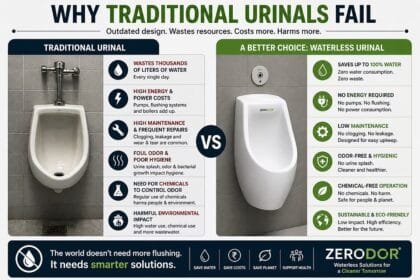
Ventilation helps remove airborne contaminants and moisture, but it should complement—not replace—cleaning. Check that exhaust fans operate correctly and that air can move through the space as intended. Inspect plumbing traps, flush mechanisms, seals, pipes and floor drains for leaks or faults. Waterless urinal systems may help reduce flushing-water demand in suitable buildings, but they still require correct installation, compatible maintenance and routine cleaning. No fixture eliminates the need for good hygiene practices.
Choose products and systems responsibly
Select cleaning products according to the surface, soil type, safety instructions and facility needs. Never mix cleaning chemicals unless the product label explicitly permits it; mixing incompatible chemicals can release hazardous gases or cause dangerous reactions. Biological or enzyme-based products may be appropriate for certain odour or drain-management applications, but they should be used for their stated purpose and should not be treated as a universal fix. Persistent or unusual odours may require a qualified plumbing or building-maintenance professional.
Measure results instead of relying on fragrance
Facility managers can track restroom complaints, repeat cleaning needs, supply use and inspection scores. A simple log can show whether odour returns at particular times, after peak usage or near specific fixtures. Use these observations to adjust cleaning frequency, repair defects and improve staff training. Feedback from cleaners is especially useful because they often notice recurring problem areas before occupants report them.
Conclusion
Restroom odour is often a sign that residues, moisture, ventilation or maintenance need attention. By understanding how urea can break down into ammonia, cleaning hidden splash zones, maintaining plumbing and selecting appropriate products, building teams can address the source rather than merely covering the smell. Ekam Eco Solutions shares practical perspectives on sustainable sanitation and hygiene at ekameco.com. A consistent, evidence-informed approach helps facilities maintain cleaner, more comfortable restrooms while using water and cleaning resources thoughtfully.
A practical implementation checklist
A useful next step is to assign an owner to each improvement and record the expected completion date. Document the current condition, the action taken and how the result will be checked. Where a change affects sanitation, wastewater, chemical handling or worker safety, consult the relevant technical guidance and applicable regulations before implementation. Pilot a change in one area, gather feedback from staff and users, and expand it only after confirming that it works as intended. This measured approach reduces guesswork, supports accountability and makes it easier to explain the value of the programme to management and stakeholders.