Contactless technology is becoming an increasingly visible part of modern business. People tap payment cards, smartphones and access credentials every day. As familiarity grows, businesses are finding new ways to connect physical objects with digital systems.
NFC and RFID are two technologies contributing to this transformation.
NFC, or Near Field Communication, is designed for short-range communication. RFID, or Radio Frequency Identification, covers a broader range of systems that use radio signals to identify and communicate with tagged objects or credentials.
Their applications can be very different, but both can help businesses create more connected physical environments.
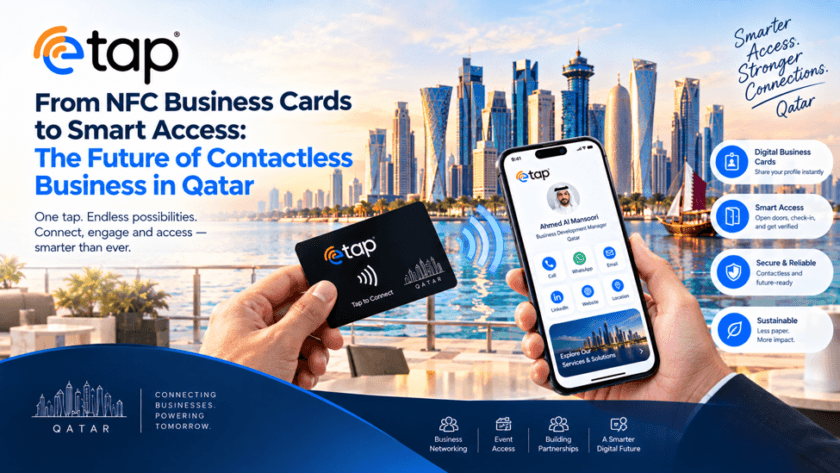
The simplest NFC application for professionals is the digital business card. A physical card contains an NFC chip that can open a digital profile when tapped. The profile can contain contact details, WhatsApp, LinkedIn, websites, portfolios and appointment links.
The benefit is flexibility. The physical card remains the same while the digital information can be updated.
Beyond networking, NFC can support smart membership experiences. Gyms, clubs, associations and loyalty programmes can use contactless cards or tags as gateways to digital information. A tap could lead to membership details, offers, event information or customer support.
Retail is another potential application. An NFC-enabled product display could direct customers to product specifications, instructions, warranty information, videos or customer support. This adds a digital layer to a physical product.
Hospitality businesses can use similar ideas. Hotels can connect guests with services and information, while restaurants can provide digital menus, loyalty programmes or review pages.
NFC and RFID may also form part of access-control systems. Offices, hotels, residential buildings and facilities can use suitable contactless credentials for controlled access. However, security requirements vary significantly, so organizations should select access systems according to authentication, compatibility, security architecture and applicable regulations rather than treating every NFC or RFID product as interchangeable.
The smart-office concept goes even further. Contactless technology can become part of visitor management, room information, equipment identification and employee workflows. The objective should be to make routine tasks easier rather than adding technology for its own sake.
There is also a sustainability opportunity. When information changes frequently, businesses can use digital destinations instead of repeatedly replacing printed materials. A restaurant can update a digital menu without replacing every physical touchpoint. A consultant can update a profile without printing new business cards.
This does not mean physical products disappear. Instead, the physical product becomes a gateway to information that can evolve.
That combination is particularly relevant to Qatar’s digital transformation. Qatar National Vision 2030 places economic, social, human and environmental development within a long-term framework for national progress. Businesses adopting contactless tools can contribute to a wider movement toward smarter and more digitally enabled operations.
Local expertise is important when implementing these systems. Businesses need to consider the customer journey, hardware, digital destination, branding, data privacy, security, maintenance and measurement. A successful contactless project is therefore more than purchasing a card or tag.
etap NFC Solutions provides NFC digital business cards, custom NFC products, smart cards, NFC stickers and tags and other contactless solutions for businesses in Qatar.
The future of contactless business is unlikely to be defined by one single application. Instead, NFC and RFID can become invisible infrastructure connecting physical products, people and digital services.
A business card can become a digital identity. A product display can become an information portal. A membership card can become a customer-engagement tool. A physical space can become connected to a digital service.
The most effective technology will often be the technology that feels simple to the user.
In Qatar, as businesses continue to modernize their operations and customer experiences, contactless technology has an opportunity to become a practical part of everyday business—not because it is futuristic, but because it makes existing interactions faster, simpler and more connected.