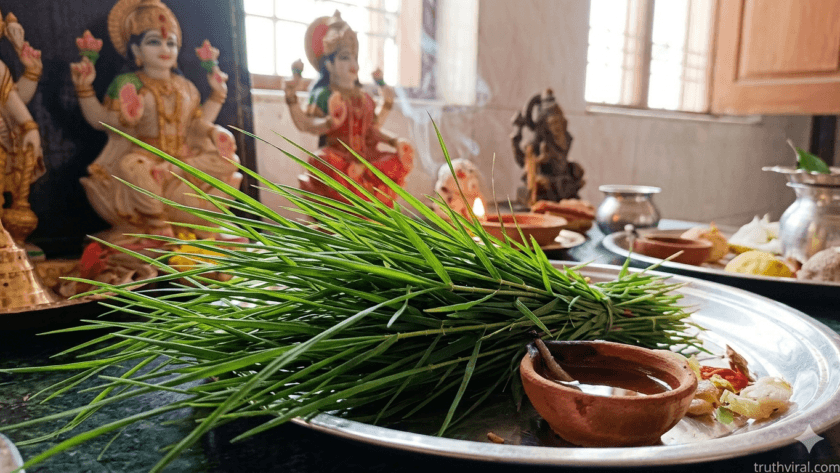
Durva grass is also referred to in the form of Cynodon Dactylon is a sacred and healing plant that is found in India. Often, it is referred to as “Doob,” “Bermuda grass,” or “Hariyali”, it has a prominent place in Ayurveda as in Hindu rituals, specifically when it comes to Lord Ganesha ceremony. Many people mistake normal grasses with durva, but finding the real plant is crucial if you intend to make use of it for puja or other medicinal uses. Let’s explore the physical characteristics, the traditional sources, and methods to distinguish the genuine durva grass.
1. Botanical Features of Durva Grass
- Scientific Name: Cynodon dactylon
- Family Poaceae (grass family)
- The Growth pattern: This grass is an elongated grass that spreads rapidly across the ground via runners.
- Stem The stem is thin, smooth and forms nodes from where new roots and shoots develop.
- Leafs A narrow, 2- 15 cm in length Light green to greyish-green and softly textured.
2. Leaf Identification
Leaves are among the simplest method to identify durva:
- Form: Flat, narrow and pointed towards the point..
- Surface: a little rough at the base, but smooth across the blade.
- The leaves grow in a series on the stem.
- Color: A distinct vibrant green that appears fresh in bright sunlight.
3. Flowers and Inflorescence
One distinct feature that assists in identifying durva grass is the flower it blooms in:
- The flowering stalks are atop the leaves.
- Inflorescences typically have three to seven slender spurs radiating from one point, resembling fingers on hands.
- Spikelets (tiny blooms) are tiny with a greenish-purple hue.
Its “finger-like” flower structure is an indication it is dwarve.
4. Root and Growth Habit
- Durva spreads through the use of stolons and rhizomes (underground runners above ground and underground).
- It is a mat-forming plant, that cover the entire soil which makes it a perfect ground cover.
- The roots are fibrous, which makes grass drought-resistant and capable of growing even in soils that are poor.
5. Sacred and Cultural Identification
Durva grass can be easily identified in the context of religious practices:
- It is usually provided with unusual numbers (3, 5, 7 or 21 blades joined with) to Lord Ganesha.
- When they are tied together when tied together, the tips of the grass blades create a small pointed cluster that is a unique characteristic of durva.
- Other grasses when tied do not make such a neat and sharp clump.
6. Difference Between Durva and Common Lawn Grass
| Feature | Durva Grass | The Common Grass (e.g. lawn grass, wheat grass) |
| Leaf shape | Flat, narrow, pointed | A little more round or wide |
| Flower | 3-7 finger-like spikes | No such distinct spikes |
| Growth | Spreads through runners | The plant grows upright in clumps. |
| Religious use | The sacred in Hindu rituals | This is not a puja ritual. |
7. Medicinal Properties for Identification
Another method of confirming the medicinal value of durva in Ayurveda:
- Applying durva or chewing on it gives the taste of sweet, mild.
- It can stop bleeding when applied to cut.
- The juice that is extracted from the durva plant is mildly cooling and employed in traditional remedies to treat nosebleeds, urinary issues, and urological problems.
These properties aren’t present in grasses that are commonplace.
8. Where to Find Durva Grass
- Typically, they can be found in fields gardens, open areas and along roadsides.
- The best growth occurs in tropical climates that are warm and humid such as India.
- It’s evergreen and is all year round.
Final Thoughts
The identification of the durva grass is as simple as looking at its small pointed leaves, the shape of finger-like flower spikes, a creeping growth pattern, and the evergreen colour. The sacred significance and healing properties distinguish it from other grasses. It is believed that in Indian homes, particularly when it is Ganesh Chaturthi festival, they make sure they get only the authentic durva, since any other kind of offering is thought to be not to be a blessing.
By following these tips for identification you will be able to easily identify pure durva grass around you and make use of it with confidence to worship as well as health benefits.